








Here's something that used to drive me crazy: I'd send out a batch of offers, get a few people interested, have some good initial conversations… and then they'd go silent.
And I'd just move on to the next batch of prospects, thinking “well, I guess they weren't serious.”
Turns out, I was walking away from the majority of my deals. And if you're doing the same thing, you probably are too.
According to research, most businesses generate about 70% of their revenue from follow-up, NOT from the initial conversation.
Let that sink in for a second.
If you're not systematically following up with your prospects, you're potentially leaving seven out of every ten dollars on the table.
I know what you're thinking, because I thought it too:
“But Seth, follow-up feels pushy. I don't want to be that annoying person who keeps bothering people.”
I get it. I had the same hesitation. But the problem is, most people fundamentally misunderstand what follow-up actually is and when it should happen.
Once I figured out the right way to think about follow-up (and more importantly, when to pick up the phone myself vs. automate it), everything started to click.
Let me walk you through the same framework that's helped me and hundreds of other land investors stop leaving money on the table.
The Surprising Truth About When Follow-Up Actually Starts
Most people think follow-up begins the moment you send your first mailer or text message. It doesn't.
That's what we call “outbound marketing,” which is a completely different thing.
Follow-up doesn't begin until AFTER a seller raises their hand.
If someone never responds to you, there's nothing to follow up on.
And if someone responds with anger or tells you to stop, they're not a lead either. They should be removed from your list immediately.
So, when does real follow-up begin?
It starts the moment a seller responds with anything even remotely positive or neutral.
When they say things like “make me an offer,” or “I might be interested,” or even just “tell me more,” that's when follow-up becomes relevant. Before that moment, you're still in cold outreach mode.
This distinction matters more than you might think, because a lot of investors waste time and energy trying to automate conversations that haven't even started yet.
The Three Seller States That Determine Your Follow-Up Strategy
Once you understand that follow-up only happens after someone responds, the next step is recognizing that every seller falls into one of three distinct states. And each state requires a completely different approach:
State #1: Not a Lead
This includes sellers who:
- Never responded at all
- Responded negatively
- told you to stop
- Have a property you simply can't use
There's no follow-up required here. None. No automation, no reminders, no tasks.
These people don't belong in your deal pipeline, period.
State #2: Qualified Lead in Active Conversation
This type of seller responds and engages. They're answering your questions, showing genuine interest, and you're having a real back-and-forth conversation with them. They might have given you an email address, a phone number, maybe even some details about their property.
Here's the critical thing to understand: this stage is mostly manual.
This is where you or someone on your team should be responding with real calls and real conversations. Software can help you remember to call and organize your notes (which is huge), but it cannot replace the human conversation or close the deal. At least not yet. If a seller is actively talking to you, automation should support the human having those conversations, not replace them.
State #3: Non-Qualified Lead Who Fell Silent
This is the type of seller who seemed interested at one point, maybe answered some questions, but then stopped responding.
The property might still be good; you made some progress, but something is keeping them from moving forward. Maybe the timing isn't right. Maybe they're distracted. Maybe they temporarily changed their mind.
This is the only place where automated follow-up truly belongs, and this is where automation really shines.
The Follow-Up Engagement Matrix (Visual Guide)
When I tried to explain this clearly, even to myself, I realized I kept picturing a flowchart in my head. Different seller responses put them into different buckets, and each bucket deserves a very different next move.
So I tried to turn that mental picture into something visual.
The diagram below shows exactly when follow-up should be human, when automation makes sense, when long-term follow-up is okay, and when it’s time to stop communicating altogether.
It’s not about bothering people until they say yes. It’s about responding the right way, at the right time, based on how the seller is actually engaging.
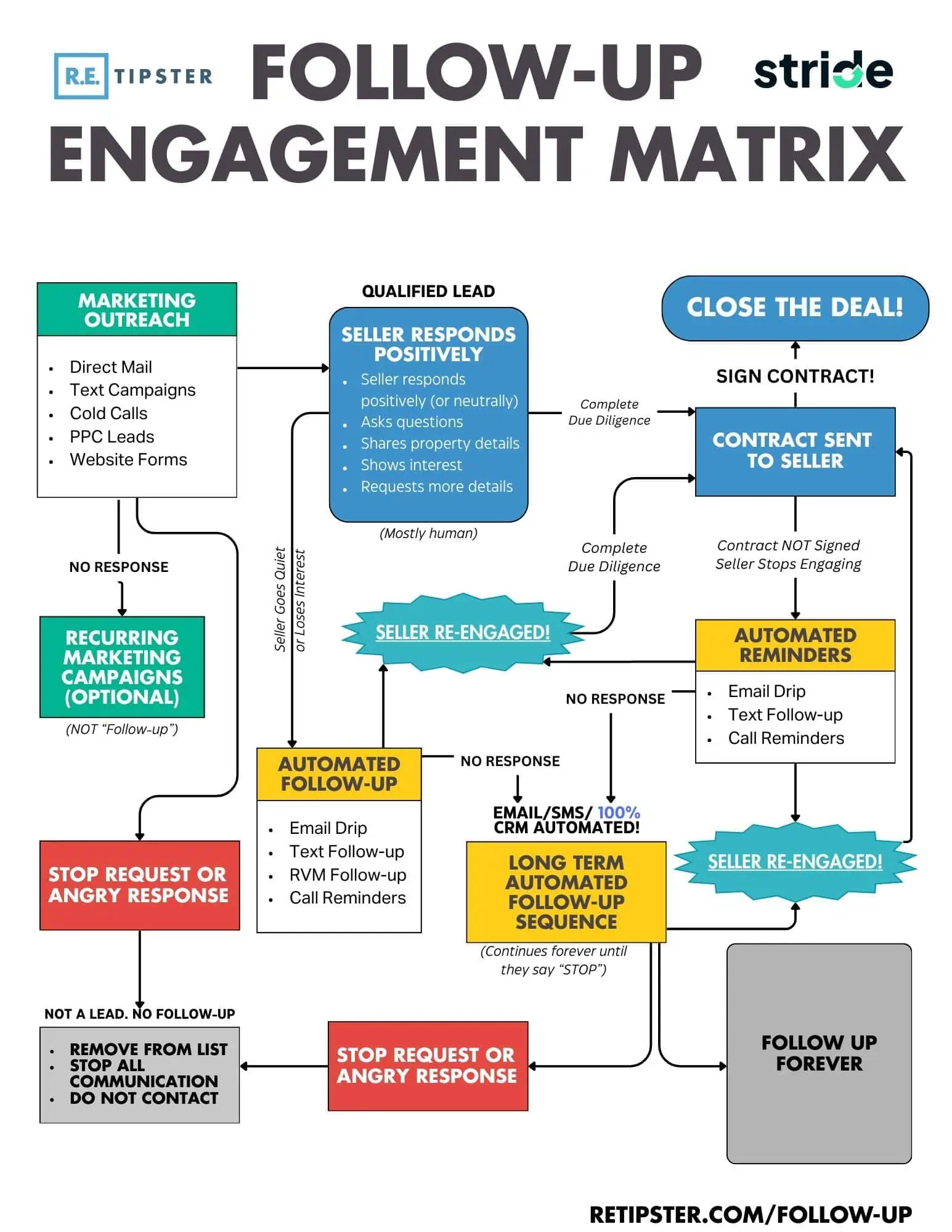
If you’ve ever felt unsure about whether to follow up, automate, or walk away, I hope this helps it click.
And if you find this helpful, feel free to share it with your team or anyone who struggles with follow-up. That’s exactly why I made it!
Turning This Framework Into a System
One of the reasons I created this framework is that knowing what to do is easy, but doing it consistently is the hard part.
 This is where Stride helps.
Inside Stride, we’ve already built the follow-up workflows shown in this diagram above.
Automated texts, emails, RVMs, and reminders for sellers who go quiet. Call prompts and task reminders for sellers who need a real human conversation. Long-term follow-up that runs quietly in the background without feeling pushy.
You don’t have to figure this out from scratch. You can review what we’ve already built, tweak the wording to sound like you, choose the channels you want to use, and then turn it on.
Stride doesn’t replace conversations. It supports them, so nothing falls through the cracks when sellers go silent.
That way, this matrix isn’t just a nice idea. It becomes a system that actually runs in your business.
What the Harvard Business Review Study Teaches Us About Follow-Up
There's a well-known Harvard Business Review study that analyzed many thousands of leads and over 100,000 contact attempts. The findings are pretty eye-opening:
- First, speed matters more than almost anything. If you respond to a lead within five minutes of them reaching out, you're dramatically more likely to actually talk to them than if you wait just 10 minutes. That's right. A few extra minutes can reduce your chances by multiples.
- Second, timing matters beyond just speed. The middle of the week works better than the beginning of the week. Late afternoon works better than most other times. This applies across industries, not just land investing.
- Third, persistence pays off. Your chances of reaching someone go up with each additional attempt, and by the sixth attempt, your odds of making contact are extremely high.
The key takeaway is that most deals don't happen on the first conversation. They happen after multiple touches, at the right times, with the right people saying the right things.
Where Automation Fits (And Where It Doesn't)
Here's the thing about automation: it has a very specific job, and the moment you confuse that job with something else, your follow-up starts to feel spammy instead of helpful.
Automation is excellent at re-engaging silent leads, reminding your team when to act, and maintaining consistency over time. It's also great for things like appointment reminders, which build trust by showing you're organized and serious about following through.
But automation is TERRIBLE at negotiation, making judgment calls, and reading human emotion. That's just not what it's designed to do.
For example, when someone goes silent after initial conversations, you can put them into a simple drip sequence that gently reminds them you exist over the next several months. These sequences have helped land investors (myself included) close deals that would have otherwise been completely forgotten. Not every silent lead will convert, but some will, and those “some” can add tens of thousands of dollars to your bottom line with zero additional effort on your part.
The Simple Framework That Actually Works
If you take nothing else from this, remember these three principles:
- There is no follow-up until a seller responds.
- There is no automation until a conversation stalls.
- The best follow-up systems support humans rather than replace them.
You don't need a complex system to make this work. Start simple. Don't follow up until somebody responds. When they do, talk to them like a human. If they go silent, then put them into a simple automated sequence that keeps you top of mind without requiring constant mental bandwidth from you.
That's it. That's the system that's helping land investors across the country stop leaving 70% of their revenue on the table.
And in a business where most people aren't doing systematic follow-up at all, just implementing these basics will put you miles ahead of your competition.
Now, if you'll excuse me, I have some follow-up calls to make.