









What I'm thinking about: Even after reviewing tens of thousands of land deals, we are still finding new levels of nuance in underwriting.
Just when you think your team is locked and loaded, when you have got your systems dialed in and your comp analysis down to a science (or at least as close to a science as land allows), the market throws you a curveball that reveals another layer of complexity you had not fully considered.
And honestly? That is exactly what keeps this business interesting.
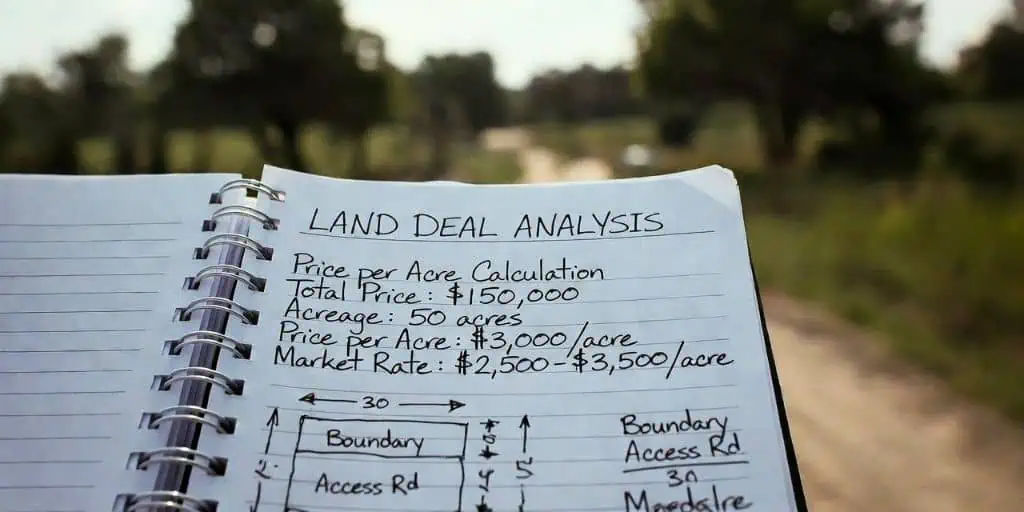
Case in point: We are about to fund an East Texas property right now. Rural area, over 20 acres, $3,000 per acre purchase price.
The sold comps in this area range from roughly $4,000 per acre to $7,500 per acre. An almost 2x variance in exit pricing… all within the same general market area.
So which number do you underwrite to?
This is where most land investors (even experienced ones) wildly overestimate their own abilities.
The Problem With PPA (average price-per-acre)
For the above, if you just take the mean of all those comps, you would land around $5,200 per acre for your exit assumption.
Plug that into your spreadsheet. Call it a day.
(This sounds so simplistic, to the point where I debated including this section, but I still see this all the time. From realtors, to land investors, to large lenders with “sophisticated” appraisal teams.)
And more often than not, averaging PPA gives you a number that is higher than what the subject property is actually worth. Some folks certainly leave opportunity on the table by not pulling the trigger when more margin is available than they think, but that is exceedingly rare, in our experience.
Property characteristics and CURRENT market conditions rule the roost. “Current” does not mean 12 months ago, and certainly not 24-36 months ago. Current = now.
And in this buyer's market (generally, across the US, but never forget real estate is hyper-local, do your own research), the margin for error is as thin as it has ever been.
How We Actually Score Comps
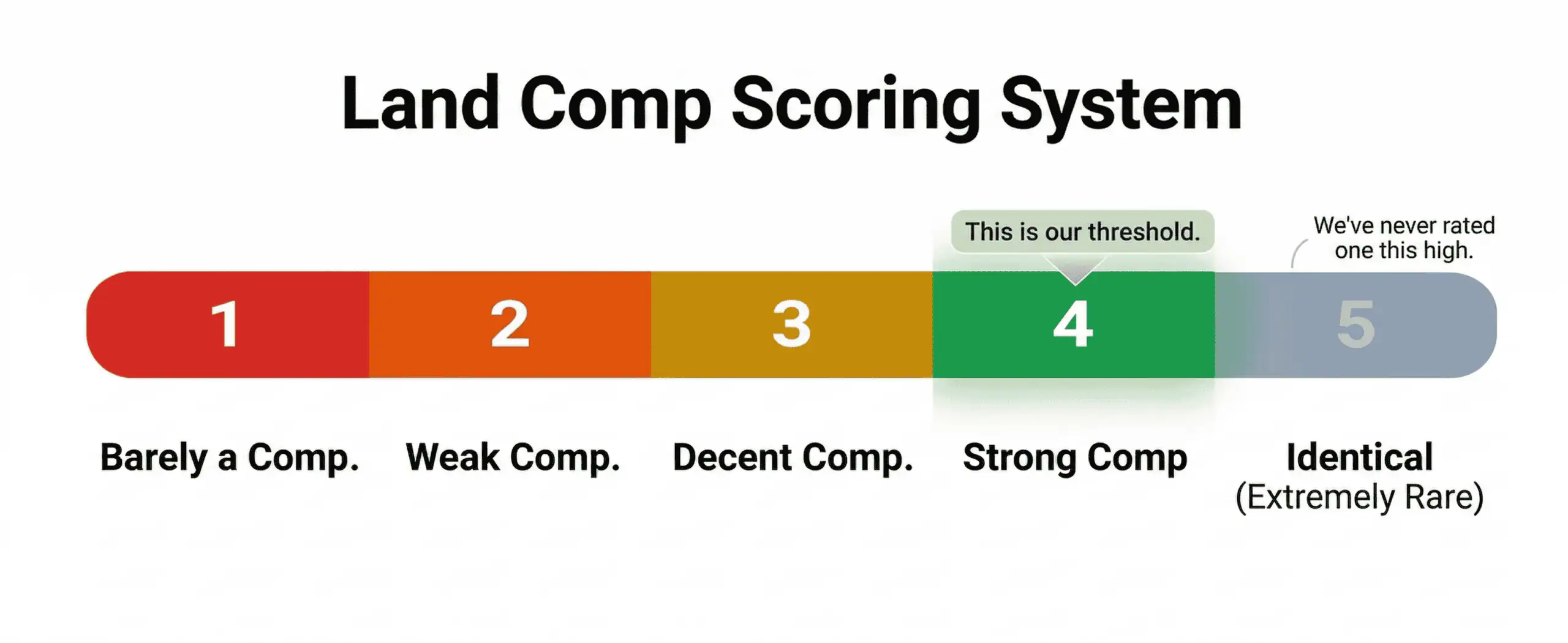
We use a 1-5 scoring system on our written due diligence questionnaire, or DDQ (feel free to save a copy), which mathematically weights pricing based on score.
Here is how it breaks down:
- Rank 1: Borderline not even a comp. Barely relevant, included for informational purposes.
- Rank 2: Weak comp, with major differences in key characteristics.
- Rank 3: Decent comp with multiple differences.
- Rank 4: Strong comp with only subtle differences.
- Rank 5: Effectively identical to the subject property (The subject property is the property you are reviewing for a potential purchase).
Here's the kicker: After reviewing thousands of properties using this system, I do not think we have ever labeled a comp at a 5. (Generally, those would be in cookie-cutter infill markets, which are usually too low-value to be a funding target.)
At best, they get to a 4. There are still subtle differences (for example, property geometry, neighborhood quality, or total road frontage).
Naturally, there is significant subjectivity involved in that scoring system, and the team needs to be trained to routinely weigh comps to the same standard, but that should tell you something about the level of nuance required to do this well.
The comp weighting is generally where I spend the most time on a final review before approving funding, and if we do not have at least one comp that rates a 4, particularly one that sold or is pending, then it is too risky to pull the trigger, unless the discount is an absolute screamer.
Non-Disclosure States Make This Even Harder
In non-disclosure states, like Texas, you cannot just pull sold prices from public records.
We have an algorithm that helps us estimate sold prices based on days on market (DOM), the number of days properties pended after the previous price cut, among other factors, but nothing beats the true data.
We ALWAYS send our sold comps to our realtor and ask them to verify the true exit pricing through MLS access. Sometimes our estimates are accurate, and sometimes they are significantly off.
(Notably, exit pricing can only be confirmed for properties that sold on the MLS. If a property sold off-market, and the purchaser did not use conventional financing, those sold prices will still be hidden.)
A lot of folks might accept a comparative market analysis (CMA) from a realtor with true exit pricing, but you or your team should always prep your own comp list. I can count on one hand the number of times a realtor, even experienced ones, have prepped a comp list that matched our internal one in quality and comprehensiveness.
When it is your capital at stake, no one will care as much as you. Never forget that. Trust, but verify.
And in particular for sold comps that our realtor listed, or was the buy-side agent on (typically we are engaging realtors based on their recent market success, so they should have at least one relevant sold comp), we grill them on the exact circumstances of the sale, and how the property characteristics line up in relation to the subject property we have under contract.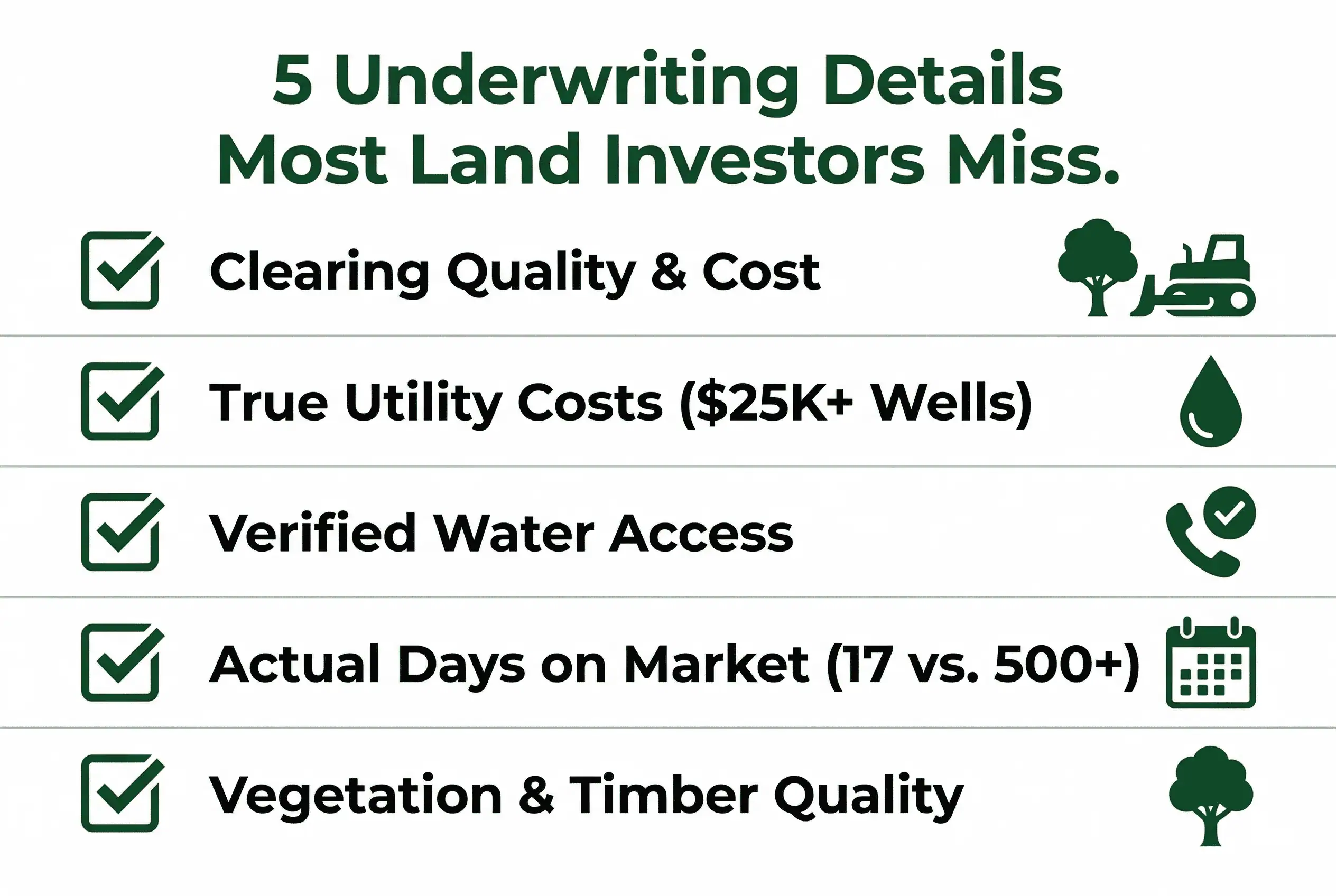
For this East Texas property, here are some of the questions we had to answer before committing:
- What does “clearing” actually mean in this market? Our realtor suggested mulching and clearing a home site for the subject property, and came back with a $4,000 quote. Not all clearing is created equal though. We showed the realtor photos of cleared comps that sold at ~$7,500 per acre, and confirmed our contractor could match that quality at the current quote, reinforcing our pegged valuation.
- What is the true cost of utilities? Most comps have public water access. But if a buyer does not have access? Wells cost $25,000 or more in this area. That is a massive surcharge that dramatically impacts value, and could destroy the profitability we were anticipating.
- Where exactly is the water access? This one was tricky. We had to reach out to ~5-6 different numbers (including the local volunteer fire department) to confirm the subject property had access to public water. Even though three other comps on the same highway said they had water, we did not make assumptions. We did our own research.
- How long did comps actually sit on the market? One comp took 500+ days to sell. Another moved in 17 days. The weighted rankings were different for each of those comps, with our subject parcel closer to the comp that sold in 17 days, a critical distinction when trying to price for an ~3-6 month exit.
- Quality of vegetation on the property? The subject has mature, visually appealing trees, compared to a sold comp that is only about 4 years into a timber regeneration phase (difficult to discern from an aerial, but our realtor was able to note this as they had listed the sold comp undergoing regeneration).
This is not busy work. This is the difference between a profitable deal and a loss.
This is why, even after funding over $6 million worth of land deals with industry-leading 41% operating margins, we are still learning something new on every single property.
Eyes wide open. Be curious. Ask every question…until none remain. Trust and refine the process.
Where We Landed on This Deal
Based on painstaking, feature-by-feature analysis of every comp in relation to the subject parcel (the clearing we are adding, the superior trees, the better buildability and location in relation to population centers), we are pinning this property at a $6,000 per acre exit.
Not the $5,200 mean. Not the $7,500 top-end comp. Not the $4,000 PPA worst-case scenario.
Could we be wrong? Sure, we have been before, and it will happen again. But that is why we price for the downside scenario. We made sure there was no foreseeable scenario where the property would sell for below $4,000 per acre, before we even started to consider the update.
Rule #1 in investing (any asset class): Don't lose money.
But we have done everything possible to ensure we are not missing something critical.
And that is the game. Every single time.

Why This Market Is the Perfect Training Ground
As is endlessly noted from this newsletter, and even the mainstream media, this is a challenging real estate market.
Buyer inquiries are down. Properties are sitting longer. If you're not laser-focused on underwriting, you're going to get burned.
Just remember that this is the perfect battleground in which to hone your skills, because what works in a down market works even better in a bull market.
Conservative underwriting. Ruthless attention to detail. Triple-checking assumptions before wiring funds.
Because before the wire goes out, you can ALWAYS say no. Once it is out? No take-backs.
This is when you build your reputation. This is how you show the industry you have staying power.
And when the market turns? You'll still be standing.
The Infinite Game
Underwriting is not a skill you master and move on from.
It's an infinite game. Every deal teaches you something new. Every market shift reveals another layer of complexity.
And the operators who understand that (who respect the basics, who keep digging, and who don't assume they've got it all figured out) are the ones who win in the long term.
We are playing the 50+ year game here. The investor with the longest time horizon wins.
If you are an experienced operator with routine deal flow, and you want a capital partner who turns over every stone to ensure they get the underwriting right?
Send us your best deals. We write checks for $50,000 or more. We close 100% of deals we commit to. And we bring national underwriting experience to every transaction.
Let's grow together.
Get Your Property Analyzed Today
Originally published at https://seriousland.capital on December 22, 2025.