A distressed-property record tells you something happened. It does not tell you a deal exists.
That gap is where most outreach gets wasted. The row on your list may point to the wrong parcel, name someone who sold two years ago, or describe a case dismissed last spring. None of that is visible in a spreadsheet. All of it is visible in the county record the spreadsheet was built from.
What follows is the check I run before a record costs me anything: before skip tracing, before mail, before a call. It takes a few minutes per lead, and it is not title work. It will not replace a title search, an attorney, or real due diligence. It answers one question only: is this record worth acting on?
If you buy land, this matters more, not less. A house has a street address, a builder, neighbors who might talk to you. A vacant parcel usually has none of that. The parcel number and the legal description are often the only two things anchoring the record to a real, physical place. If you get the parcel wrong on a land deal, nothing else pulls you back to the right one.
1. Start at the Source Document
Do not start from the row. Start from the document the row was built from.
Your list should give you at least one handle: a case number, an instrument or document number, a parcel number, or a recording date. Take that handle back to whichever county office issued it (the clerk of court, the recorder or register of deeds, the tax collector, or the court docket). In most Florida and California counties, you can search these yourself online, for free. A few still charge a fee or require you to visit in person.
You are answering four questions:
- What kind of record is this?
- When was it filed or recorded?
- Who is named in it?
- Which property, or properties, does it attach to?
If the source cannot answer those four, stop. A record you cannot open is not a lead. It is a rumor with a parcel number attached.
2. Know What the Record Type Actually Means
Two records can sit in the same column of a spreadsheet and mean entirely different things in the real world.
A lis pendens is notice that a lawsuit affecting title is pending. In judicial-foreclosure states it is usually the first public sign of a foreclosure, filed near the start of the case. It is not a judgment, not a sale date, and not evidence that the owner wants to sell. In non-judicial states (California among them) the early signal is a notice of default or a notice of trustee’s sale, and the timeline runs differently.
A tax delinquency means the taxes are late, and on raw land it plays out on a longer, quieter clock than most people expect. Miss a payment and the county sells a tax certificate. Not the property, just the right to collect the debt plus interest. The certificate holder then has to wait out a statutory redemption period, which in Florida runs two years from April 1 of the year the taxes became delinquent, before applying for a tax deed. On an improved property with a mortgage, that clock rarely runs its full length; the lender usually pays the taxes to protect its lien long before a deed application is possible. On a standalone vacant lot with no mortgage, there is no lender watching it, and the certificate can sit for years with nobody paying it off. That is why tax-delinquent land lists skew toward parcels that have been quietly late for a long time. The record itself does not tell you where a specific parcel sits on that clock. You have to check.
A probate filing means an owner died and the estate is moving through court. It does not mean the heirs can sell yet, or that a personal representative has been appointed with authority to sign.
Before you decide what a record means for your outreach, decide what it is.
3. Match the Record to the Parcel, Not the Name
This is where bad rows survive longest, and it is the step land investors get wrong most often.
Names are weak identifiers. Common names repeat, middle initials come and go, and trusts and LLCs get renamed. Street addresses are weaker still on land. Most vacant parcels never had one assigned in the first place, so the county falls back to describing the lot by boundary, not by mailbox.
Match on what the county treats as the key:
- The parcel or assessor’s parcel number (APN)
- The legal description
- Subdivision, lot and block, or (in unplatted or rural land) section, township and range
- The assessor or property appraiser record for that parcel
- The property reference written into the document itself
Reading a Section-Township-Range Description
If a parcel has no subdivision plat, the legal description will read something like “the NW 1/4 of the SE 1/4 of Section 14, Township 29 South, Range 20 East.” Read it right to left: the range tells you the east-west column in the county’s survey grid, the township tells you the north-south row, and the section is one square mile inside that row-and-column intersection, numbered 1 through 36 in a fixed snake pattern that starts in the northeast corner. Everything after that (the quarter-quarter fractions) is just repeatedly cutting that one square mile into smaller rectangles.
You do not need to plot this by hand. The property appraiser’s parcel viewer will show you the shape on a map once you have the section, township and range narrowed down. What you are checking for is whether the shape the county draws matches the acreage and rough location you expected. A legal description that puts the parcel in the wrong section is the land equivalent of a wrong street address, and it is far easier to miss.
When an APN Doesn’t Match Anything
A parcel number that returns nothing is not automatically a dead lead. It is often a parcel that changed after the record was filed. Land gets split (one APN becomes several smaller ones) or combined (several adjoining APNs get merged into one) far more often than people expect, usually when an owner sells off a piece, or a new owner combines odd-shaped remnants into a buildable lot. When that happens, the old number stops resolving and a new one takes over the same ground. Most property appraiser sites keep a “prior parcel” or “parcel history” field for exactly this reason. If the number on your record is dead, search the legal description or the last known owner instead of giving up on the address.
When the parcel number and the street address disagree, believe the parcel number, and find out why they disagree before you go further. Often it is a data-entry artifact. Sometimes it is the wrong property, or a split that hasn’t caught up in someone’s spreadsheet yet.
4. Confirm Who Owns It Now
The name in the filing is not automatically the person to contact.
A foreclosure names the borrower, who may have already deeded the property away. A probate record names someone who has died. A tax record can lag a sale by months. Pull the current owner of record and the mailing address from the assessor or the tax roll.
If the owner of record is an LLC, a trust, or an estate, slow down. The question is not only who owns it, but who can sign. A manager, a trustee, or a personal representative may need authority that is not visible on the deed. You do not have to resolve that before you reach out, but you should know it is there.
Three things should line up before outreach:
- The record points at the parcel you think it does
- The county shows a current owner consistent with that record
- There is a mailing address or other contact path tied to that owner
5. Walk It: Pulling One Record Start to Finish
Here is what steps 1 through 4 actually look like on a real Florida county site. I’m using Hillsborough County as the example because both offices (the clerk of court and the property appraiser) offer free, public online search with no account required, which is true of most Florida counties and a growing number in California.
Step One: The Clerk’s Official Records Search
Start at the county clerk’s public-records portal (Hillsborough’s is at publicaccess.hillsclerk.com). Search by document type and date range, or, if your list already gave you an instrument or case number, search on that directly.
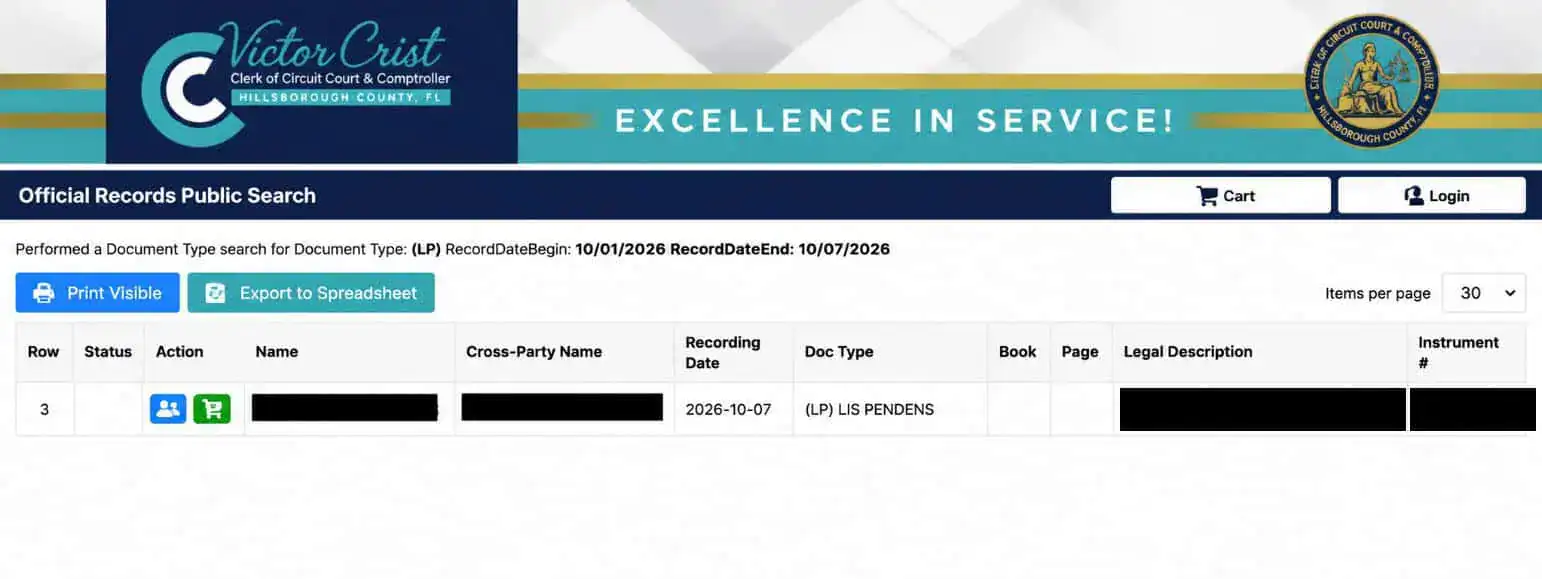
The clerk’s index for one lis pendens: document type, recording date, and the party names, before you’ve opened anything.
Open the actual filed document, not just the index line. You’re confirming: the document type matches what your list called it, the filing date matches, and the legal description or parcel reference printed on the document itself is legible.
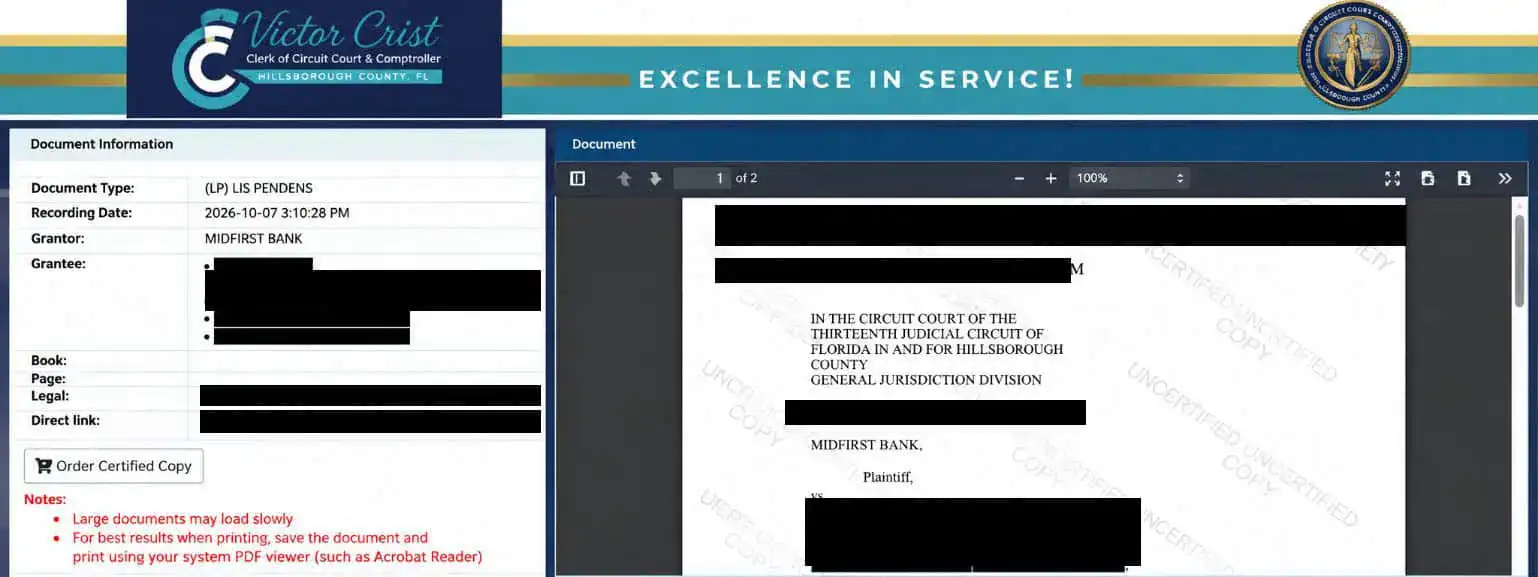
The filed document itself. The document type, recording date, and lender are visible. The case number, parties, and legal description have been redacted here.
Step Two: Take the Parcel Number to the Property Appraiser
Hillsborough’s property appraiser runs a public parcel search at gis.hcpafl.org. Enter the APN (or, if you don’t have one yet, the address or owner name) and pull up the parcel record. This is where you check land use, situs address if one exists, and (the part that matters most) the current owner of record and their mailing address, which can be completely different from the property address.
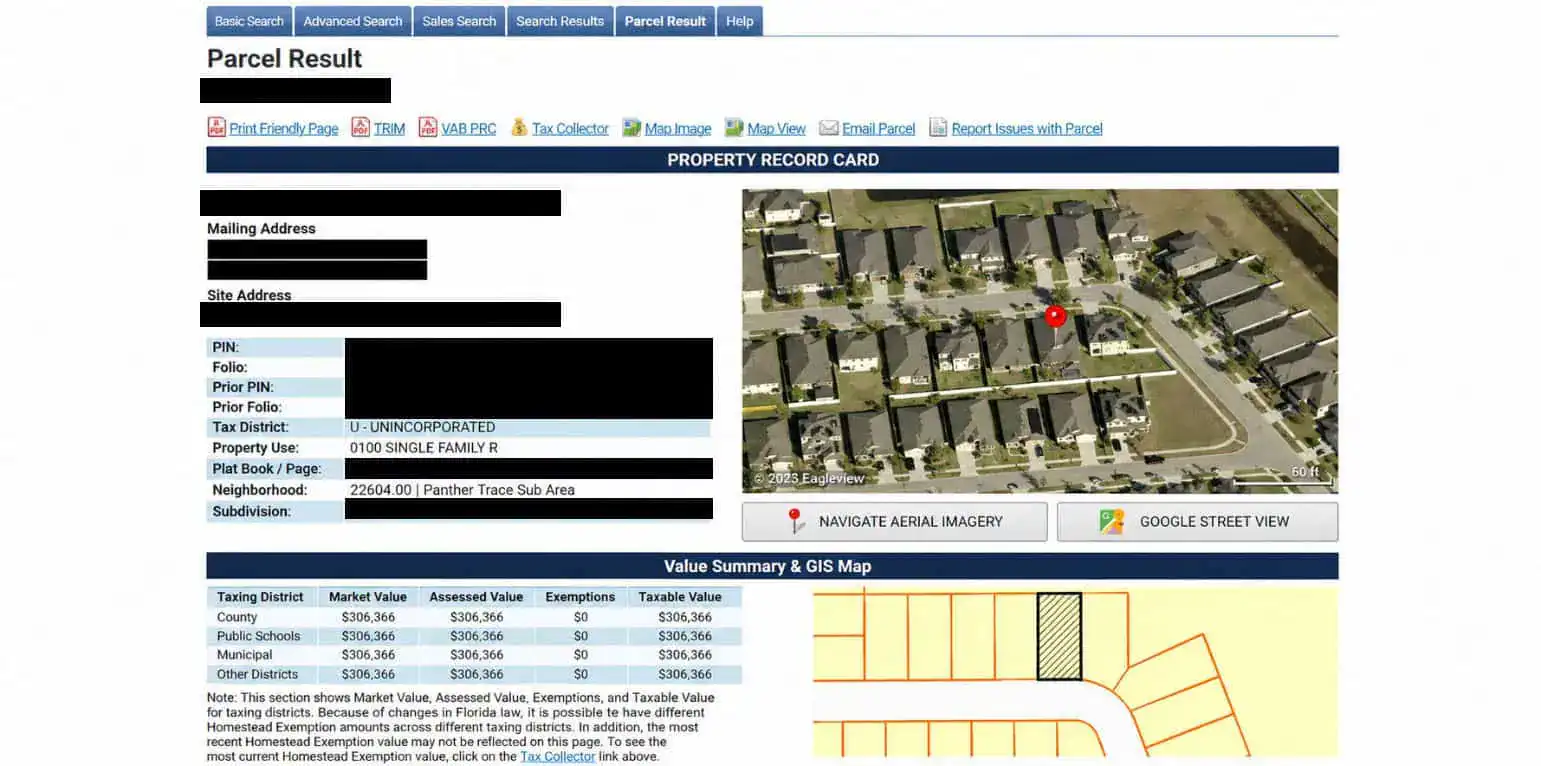
Same parcel, from the appraiser’s side: owner of record, mailing address, land use, and the parcel map, independent of whatever the clerk’s filing says.
Step Three: Compare the Two
Does the legal description on the appraiser’s parcel record match what the clerk’s document says? Is the owner of record on the appraiser’s side the same person named in the filing, or has the property already changed hands? If the case came out of a lawsuit, this is also the point where you’d pull the docket to check for a dismissal or a completed sale (more on that below).
That’s it. On a clean record with a normal address, this whole sequence takes three or four minutes once you’ve done it a handful of times. On a parcel with no address, a split APN, or an owner that’s an LLC, budget closer to fifteen, which is exactly why the next section exists.
6. Check What Happened After the Filing
A recording is a snapshot of one moment. Cases keep moving after it.
If the record came out of a lawsuit, open the docket. Many counties publish it, and some states run one portal for all of them. You are not reading it as a lawyer. You are looking for one thing: has anything happened since the filing that makes this lead pointless? A dismissal, a satisfaction, a payoff, a completed sale.
Calling an owner about a case that closed four months ago is worse than not calling at all. It tells them your information is old, and you only get one first impression.
7. Watch for Multi-Parcel and Duplicate Rows
One case is not always one document, and one document is not always one row.
A single foreclosure can name several parcels. An amended or re-recorded notice creates a second document for the same dispute. Data providers often expand a multi-parcel filing into one row per parcel, because that is the only way to attach each APN.
So five rows can be one situation.
Say an owner holds three adjoining vacant lots, each with its own APN, and the foreclosure names all three. Your list shows three rows. That is one owner, one case, and one conversation, not three leads. Count it as three and your pipeline is a third fiction.
When you dedupe, look at case number, document number, parcel number, owner and recording date together. Do not collapse on owner name alone, and do not assume a repeated case number is an error. Then pick your unit of counting (cases, documents, parcels or owners) and stay consistent. Most arguments about how many leads a list holds are really arguments about the unit.
A Lead That Looked Perfect on Paper
A few months ago I had a lis pendens that looked like the best lead on the list: good equity, no other liens, an owner name that matched cleanly across every field. It took less than a minute to pull the case at the clerk. The problem showed up on the second page. The case had been dismissed six weeks earlier, and the dismissal never made it into the feed I was working from. The filing was real. The lead was not, and hadn’t been for a month and a half.
Nothing about that record looked wrong from the spreadsheet. It only stopped being a lead once I opened the actual case.
8. Decide Whether to Pursue It
You are not proving the deal here. You are removing obvious false alarms before you spend money.
My minimum before outreach:
- Source: I opened the original record at the county or the court.
- Property: The record ties to a specific parcel I can identify.
- Owner: The county shows a current owner that makes sense with the record.
- Status: Nothing in the public record says this is already resolved.
- Duplicates: I know whether repeated rows are parcels, amendments, or true duplicates.
- Contact: There is a mailing address or other path to the current owner.
If one of those fails, the lead goes back in the queue instead of into a mail run.
The Five-Minute Triage
You do not need a title search on every row. On a long list, this is the pass that pays for itself.
| Check | What you want to see | Stop if |
|---|---|---|
| Source record | The original filing at the county or court | You cannot find or open it |
| Property match | APN, legal description and assessor record agree | The record points at a different parcel |
| Owner match | A current owner consistent with the record | Ownership clearly changed, or the names conflict |
| Case status | No dismissal, satisfaction or completed sale | The signal is stale or already resolved |
| Duplicates | You know why rows repeat | You cannot tell parcels from amendments |
Be honest with yourself about what this costs. A clean record with a street address takes three or four minutes. A messy one (a trust, a multi-parcel filing, a split APN, a county with a slow portal) takes fifteen. That is fine on twenty leads. On four hundred it is a week of mornings, and the temptation is to skip it and mail the whole list.
So decide where your line is before you are staring at the list. Some investors verify everything and work fewer counties. Some verify only what passes a cheaper filter first: equity, absentee mailing address, property type. Some pay for a source that has already tied the filing to a parcel and a current owner, and spot-check it. All three are defensible. Mailing four hundred unverified rows and calling it a campaign is not.
What This Process Does Not Tell You
This tells you whether a record is real, current, and attached to the property and owner you think it is. It tells you nothing about value, condition, access, easements, wetlands, or title problems you have not found. On land, those last few matter more than they do on a house. Those questions come next, and they cost more to answer. That is the entire argument for doing this first: every bad row you catch here is money you do not spend later.
The Bottom Line
The best distressed list is not the longest one. It is the one where you can explain every row.
Go back to the source, match the parcel, confirm the current owner, check the status, and understand your duplicates. It adds a few minutes per lead, and it removes the hours you would otherwise spend chasing a property that was never available.
A distress record is a signal. Verification is what turns it into a lead.
 Ziad Mahmoud is a co-founder of Lispend, where he works with distressed-property records from Florida and California county sources. His work focuses on verifying data, identifying property owners, and handling the less glamorous but essential task of keeping property lists accurate and reliable.